Saturday, August 25, 2012

The 4 Stages of the Stack Bandage

For those of you in the equine veterinary world. . . this post will be extremely entertaining.  For those of you not in the equine veterinary world. . . this post will also be extremely entertaining.
"Why didn't she just say that everyone would find this post entertaining?"

I would like to introduce you non-horsey folks to a concept called, "The Modified Robert Jones Bandage." A modified Robert Jones bandage is the single most common bandage used in the equine hospital.

These are your materials, and they are applied in the following order;

1) Combi roll or thick roll cotton


2) Brown Gauze
3) Vetrap

4) +/- Elastikon
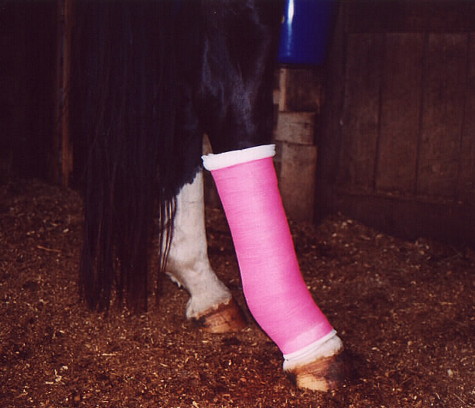
The finished product, depending on the leg, location and reason for the wrap, usually resembles this distal extremity, hind limb bandage.


Most horses are very used to having a wrap or boot of some kind on their leg.  Sometimes they are placed for shipping, as in the case of this fashionable little fellow . . .


. . . and most commonly for protection during exercise . . . .


Still, while most horses are used to some sort of bandage on the lower portion of their leg, they are often unaccustomed to having a bandage on the upper, or proximal portion, of the limb.

This is where our story begins; 
The majestic horse. . . .
Graceful. . . .
Elegant. . . .
Athletic. . .
and completely accident prone.

There is a saying that if you place a horse in a padded room, he will find a way to hurt himself and it is 100% truth.  I attribute a great deal of that truth to the fact that horses are prey animals, and as such, their first instinct is to run.  Unfortunately, if you are living in a 12x12 box stall, there isn't a whole lot of room to run. Yah, those walls come up pretty quick.  The majority of horses that I see injured in a truly traumatic event, who are also kept out on a large pasture, are injured by barbed wire.  I don't blame that on the horse.  I blame it on the wire.

So what happens when a horse injures their carpus (knee)?


or tarsus/hock (ankle)?


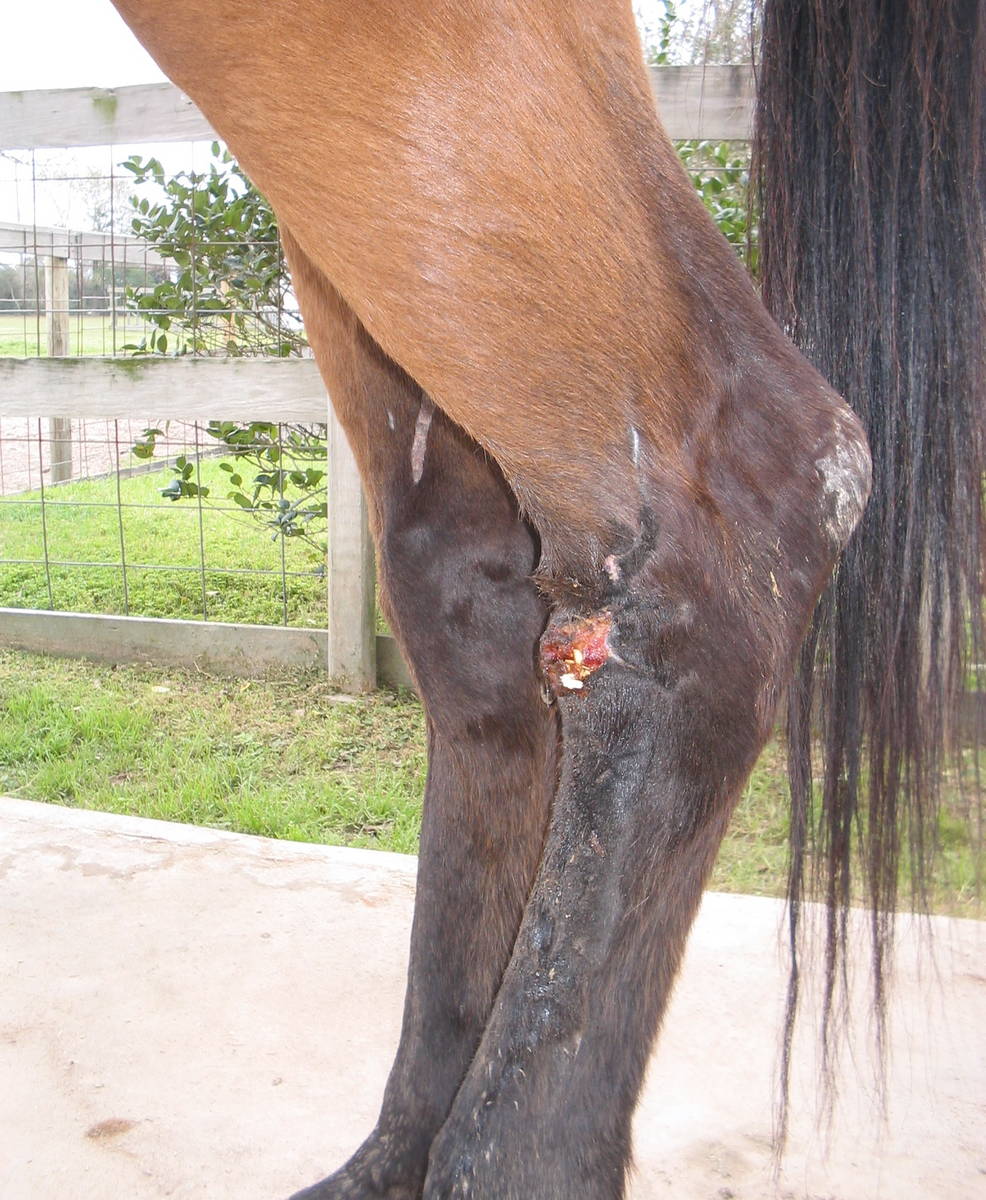
Well that's when you have to place a STACK BANDAGE. A stack bandage is just one modified robert jones placed above another, in an ascending fashion, with some overlap of the bandages.  This does several things.  It covers the affected area and it also decreases the mobility in the limb.  This is particularly important if you have a wound over a high motion area or a joint, like this one on the dorsal (front) aspect of a horse's hock. . .


The problem with these bandages is that you are taking a flight animal and essentially immobilizing or greatly reducing the mobility of one of their legs.  How well do you think that goes over?  Well it goes over something like this. . .

First, the horse is sedated to apply the bandage.  I call this the "blissfully unaware" stage.
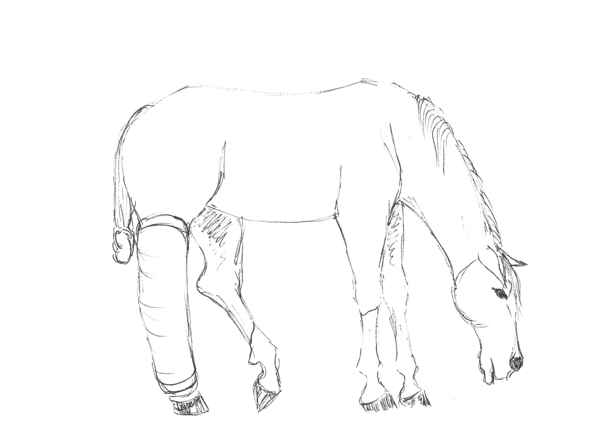


Stage 1: Blissfully Unaware


Secondly, as the sedation begins to wear off the horse enters stage 2 or the "Recognition" stage.


Stage 2: Recognition


Thirdly, the sedation is blasted off its receptors by a surge of adrenaline and the horse enters the third, "Escape" stage.


Stage 3: ESCAPE!


Stage 3 or "Escape" stage, can go on for a prolonged period of time.  The horse seems to be convinced that there is a lion or bear attached to its leg.  Rather than attempting to use the limb, it chooses holding the leg up at a nearly 90 degree angle to its body, which inevitably causes it to fall away in the opposite direction.

I have literally seen entire rooms destroyed by a horse in the "Escape" stage as it levitates its limb around the room while simultaneously trying to run away from it.  The best thing to do is to try and get these horses moving forward.  There are rare occasions where a horse does not make it past "Escape" stage and the bandage has to be modified further.

However, most horses at least make it to their stalls, where they enter the fourth stage, "Resignation" stage.


Stage 4: Resignation


Horses in "Resignation" stage may be resigned to the situation, but they are still convinced that there is a lion attached to their leg.  Horses in this stage often will not move, even for food, and it is important to make sure they are within reach of food and water.  Upon moving, "Resignation" horses may lapse back to the "Escape" phase, as they are further reminded of the bear on their hind limb.

Then one magical day, you walk into the stall and the horse is walking around and acting like nothing ever happened.

It can be frustrating working with these horses.  Here you are trying to immobilize their limb and they are doing acrobatic feats just to get away from your stack wrap.  Its important to remember that they are a flight animal and that they simply don't understand.  Everyone gets frustrated with them at times.  Especially when you take the magic worm-hole and go straight from stage 1 "blissful ignorance" to stage 3 "Escape" in the middle of trying to wrap the leg.  Usually in these moments all the bandaging material goes flying, becomes ripped or falls to the ground and you are left to start all over again.  Still, if it wasn't challenging, anyone could do it right? 
That's why we became horse vets right?!
We bandage the unbandagable!

Until next time!

Thursday, August 2, 2012

Sitting on a colic


Well, I'm sitting here in medical records. What am I sitting on? Literally or figuratively? Literally I'm sitting on a stool at a computer. Figuratively, I'm sitting on a colic. That means, I'm waiting to see if it needs to go to surgery or not.

Now on some level, every colic is exactly the same.  For those of you who don't know, a horse that is colicking is a horse with a belly ache.  I could go into all the details of extra-gastrointestinal reasons for colic, gastrointestinal reasons for colic, colic of the small intestine, colic of the large intestine, strangulating vs. non-strangulating but suffice it to say that a colic can be caused by many things.

Likewise, the horses show up with varying clinical signs. This last weekend I received 5 colics. . . . I'm just going to let that sink in with you. 5. 5 colics. Okay lets move on. So I had these 5 sick horses show up over the weekend and this was what they looked like.


Horse 1: Looked a little crampy, a little bit sweaty, and needed sedation to stay comfortable.

What Horse 1 looked like (not actually horse 1)

Horse 2: Looked like it was put out at having been dragged out of bed at this hour. Couldn't, for the life of it figure out what we were doing or why.
What horse 2 looked like (not actually horse 2)

Horse 3: Arrived agitated and threatened to do several of us bodily harm because he was scared. Became painful enough to kick out while in the stocks. . . very nearly taking my femur with him, and needed sedation to calm down.

What horse 3 acted like (not actually horse 3)

Horse 4: Showed up in a full body sweat. This horse was attempting to throw itself down onto the ground in fits of pain and was refractory to all but the strongest of pain medications we could give it intravenously.
What Horse 4 looked like (not actually horse 5)

Horse 5: Arrived at 5am (sad face). This horse was more worried about the muzzle we put on its nose, than its belly ache.

What Horse 5 looked like (not actually horse 5)

So there you have it, the spectrum. Generally speaking we think of horses with worse lesions being more painful. "Wow, did you go to vet school to learn that kind of logic doc?" BUT! These are horses. . . so that's not always the case!

Lets look at our 5 horses and where they are at. . . 5-6 days later.

Horse 1: Horse one is doing well. She is happy eating in her stall as we speak and should be going home relatively soon. That sort of makes sense.

Horse 2: Horse 2 is still in the hospital as well. However, it looks like either secondary to or as the primary cause of her colic, she may break with colitis. She has developed fevers and is quite sick. Unexpected, is it not?

Horse 3: Horse 3 never acted colicky after his initial presentation. We sent him home very quickly because there was nothing that needed to be done. 1 day later, he was back and has since demonstrated the "colic" behavior that the owner described.  However, this behavior may not in fact be colic at all but seizure or some other type of hyperesthesia (hypersensitivity).

Horse 4: This horse was so painful we were drowing her in pain medications. She needed to go to surgery but the owner really couldn't afford it (understandable because the average colic surgery is approximately $8000 dollars). We didn't give her much of a chance with her level of pain and I was sure I would get a call around 2am to come and put her down.  Yet, when I walked in the next morning, there she was, standing, bright, alert and comfortable. Well bust my buttons was I surprised. She continues to do well.

Horse 5: Discharged 2 days later with no complications and happy as can be.

Suffice it to say, you just never can be 100% certain with a colic. They'll surprise you.
So as I sit here. . . I wonder. . . where will this horse come out? Will we have to take him to surgery? Will he buck up and come through on his own? How much longer do I have to sit here, before I get to go to bed? Can I sleep on a stool in an upright position?

Sunday, July 22, 2012

The Bottom of the Box

Today is my first day off since I started at the vet school almost 1 month ago. 1 month people! Wow. When did that happen?

I was just reading my brother's newest blog entry called, "Commercial Break," and I was inspired to touch base with everyone myself. He was talking about transitioning to a completely new life and what you decide is worth keeping and bringing into the new and what you decide to leave behind. I know exactly what Jared is talking about. That waiting period when you're anxious to begin, anxious to be established and to have things rolling. You look forward to having some amount of momentum to take up the slack when you're tired. Its like digging a hole.
 "I'm not sure where she's going with this. . . "
 Please, just bear with me. It is like digging a hole. The hardest shovel of dirt is the first. After that point, the earth is inherently destabilized by the disorganization you have created and each consecutive shovel-full is just a little easier to get out of the ground.
"Wow, she really made that work, and also, I like how sciencey it sounded."

When I was moving into the town of Cary, I would look at people walking down the street and feel so jealous of them. I was jealous that they were so comfortable walking down the street. They seemed to know where they were going. They actually had somewhere to go, things to do and they knew how to get there and do them.
Well after a month, I have to say that I still don't walk down the street, . . . but I do drive.
"She's being cheeky."
I have a few typical destinations, the hospital, Starbucks, the Harris Teeter grocery store and occasionally, Mimi's cafe. I'm starting to settle in and as the newness subsides I realize that some of the things I planned on leaving behind me, in that old life, were quietly packed away in the bottom of a box. I'm disappointed to find them there. Disappointed that I still have to deal with them.

"Therefore if anyone is in Christ, he is a new creature; the old things passed away; behold, all things are made new." -2 Cor 5:17
"And He who sits on the throne said, 'Behold, I am making all things new. . . ." -Rev 21:5

I heard a great sermon today by a man named, Trip Lee. He said that we are created in the image of God and that the work of the Enemy is to defile that image in us.

"Do not lie to one another, since you laid aside the old self with its evil practices, and have put on the new self who is being renewed to a true knowledge ACCORDING TO THE IMAGE OF THE ONE WHO CREATED HIM. . . ." -Col 3:9-10

So I've got work to do. I can't just pick these things up out of the bottom of the box and throw them in the garbage. Its like losing weight.
"Here we go again."
 No it is. When you eat things that are high in simple sugars and fats, you don't exercise and then add to that the stress of life, the universe and everything, you gain weight. The bad kind. The pudgy kind. The decrease in self-confidence kind. Well wouldn't it be nice if you could just say, okay, I don't want to have eaten those things and lazed around and stressed about all that junk and then whatever weight you had gained would just magically disappear? Well anyone other than a stick-insect knows that it simply doesn't work that way. Unfortunately, you have incorporated those things into your very being. They are a part of you and separating yourself from them takes a lot of hard work. Well the same goes for bad habits and sin and from my personal experience, the more often you give in, the harder it is to make the right decision the next time.

"I can do all things through Christ who strengthens me" -Phil 4:13

But that means I have to go to Christ. I admit that when I'm faced with the desire to sin, to make a bad choice, when I'm tempted, the last thing I want to do is come to Jesus. My sin nature hates Him and it knows that He will overcome.

My current challenge is coming to Jesus. Pushing through and coming to Jesus. Not calling my friends or family but taking it straight to the source of strength and coming to Jesus.
I had to unpack those boxes and I found something I didn't want to find but God says to me that the next time I move, the next time I reach the bottom of that box, I don't have to find it there.

So I challenge you to go up to your attic or down to your basement, . . .
"Umm, most of us live in California and don't have attics or basements. . . ?"
. . . or your closet.  Find that box and take out the thing that is buried in the bottom. Expose it to the light and come to Jesus with it.

"If we confess our sins, He is faithful and just to forgive us our sins and to cleans us from all unrighteousness." -1 John 1:9

On a lighter note. . . .
I would like to introduce you to the newest and first male member of the household. . .
This is BULLITT
Bullitt may be the only male in the house, but he doesn't take crap from anyone. Look at that menacing stare.

To read my brother Jared's blog go to: https://beehivechronicles.wordpress.com/2012/07/21/commercial-break/

Monday, July 16, 2012

Do you remember that hymn, On Christ The Solid Rock I stand?
I don't know if that is actually the name or not, but Its the most important line of the song. "On Christ the solid rock I stand, all other ground is sinking sand. . . "

North Carolina is an ocean state.  I haven't really thought of it that way because I haven't been to the coast yet.  Still, I'm told that if you walk East long enough, you'll pass through the pastures and the forests and swamps and if you manage to avoid stepping on a Copperhead you will eventually walk straight into the Atlantic Ocean.  It will be cool to see that ocean, from the ground.  I've only ever seen it from 30,000 feet above.

Its only been 3 weeks, but I can tell you that the pastures at the beginning of the journey are beautiful. They are green and they are exciting. You walk through them and they are familiar and there is a comfort in their consistency.

Then you hit the forest. Now the forest is dark, but if you are there at the right time, you experience the wonder of the fireflies. They sparkle magically ahead in the dark, . . . and its warm and there are so many sounds that you feel like you have invaded some private sanctuary, but you don't feel bad, you're just happy to be there and to experience it. Still, at a certain hour, the lightning bugs go to bed and the chorus becomes a stillness.

The swamp. . . . its hard to find a positive side to the swamp. The fireflies are there too, but they are harder to enjoy. There are brief moments of beauty, but you are constantly thinking about the Cotton Mouths and the Water Moccasins. You spend your time looking every which way, worried that they will suddenly appear next to you in the water.

Finally, you break out onto the beach and you see the ocean beyond the dunes.  You are full of joy until you realize that with each step you take, the ground shifts beneath your feet. You are walking faster but hardly gaining ground. You start to get tired. You are out of breath. Your feet are burning on the traitorous sand and then. . . you see it, . . . a rock. Was it there before? Did it appear because you were looking for it? Its mostly buried but you can make out its irregular surface and see where the sand is resting in its crevices. With one step, you are on it and then you see that it stretches before you and dives straight into the ocean. You smile. You're going to make it to the ocean after all. With mixed feelings you look back in the direction of your journey and only then do you realize that the rock under your feet rises up and bridges the swamp and its granite surface reflects light into the dark of the forest and it breaks into slabs of blue and green and borders the pastures as a stone wall.

Why is it that we always look for the rock at the very end?
Not this time.
I'm on the edge of the forest and ahead I can smell the swamp.
I'm looking for it now.

"He brought me up out of the pit of destruction, out of the miry clay,
And He set my feet upon a rock and made my footsteps firm."
-Psalm 40:2